
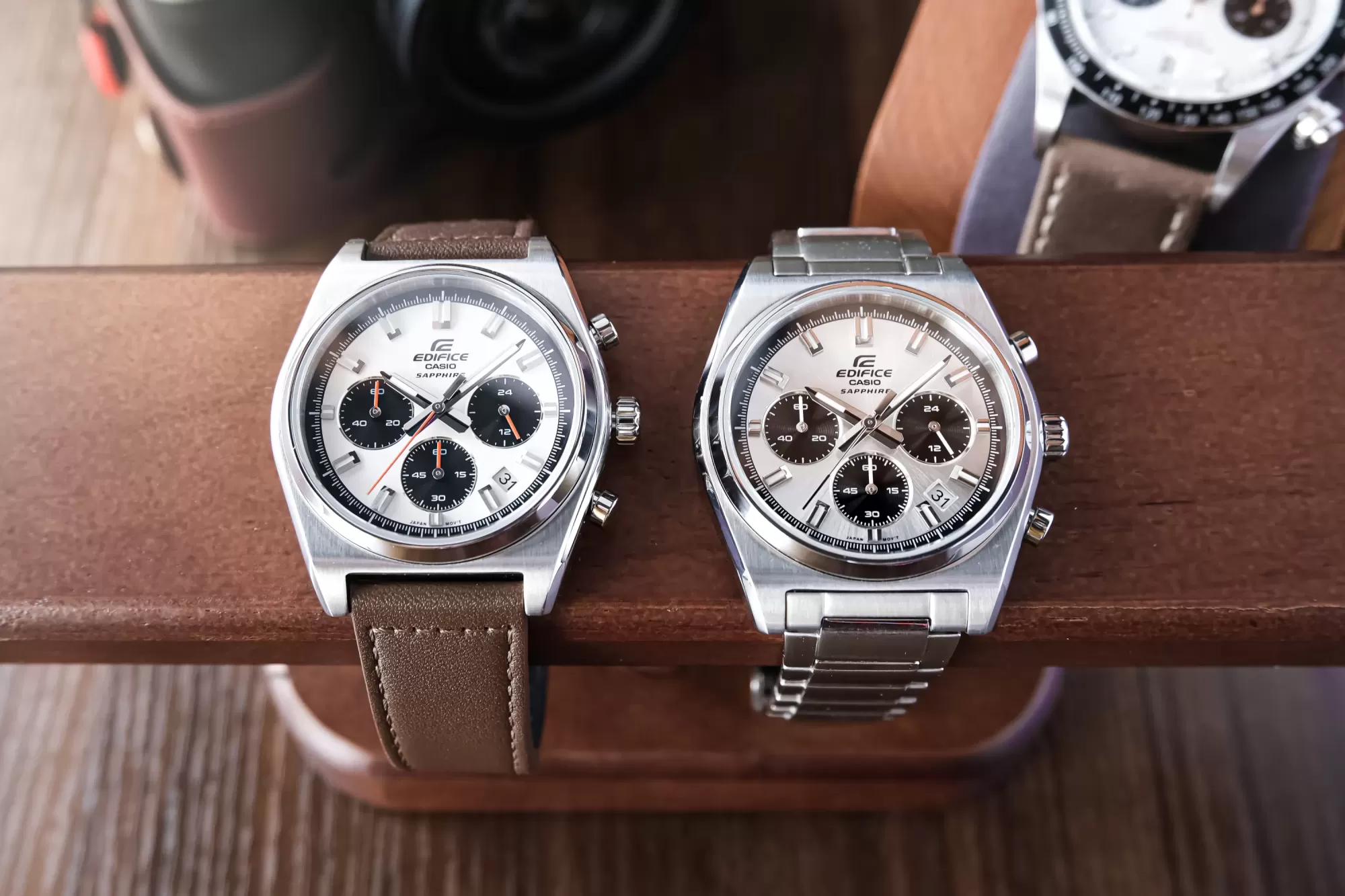

In my opinion, panda watches are probably the most beautiful and classic watch designs ever made, which explains why I own around ten of them. In this article, we are looking at two models from Casio that I own: the Edifice EFB-730D-7AV on a stainless steel bracelet, that has a clean silver dial with black subdials, and the Edifice EFB-730L-7AV on a brown leather strap, but with a more vintage off-white dial and orange accents. And to make this even more interesting I will compare them with my Tudor Black Bay Chrono Panda M79360N-0002.
In the following sections, I will cover what I like, what I do not like, or rather what I would like to see in future versions, whether these watches feel premium, and two questions you probably have in mind: why I own both and whether I am going to sell them.
Panda Design, Case Size and Comfort
The panda dial is clearly the main attraction, but what makes these Casio models stand out from the many affordable panda chronographs is the shape of the case. Instead of using the familiar round design seen on watches such as the Tudor Black Bay Chrono, the EFB-730 has a tonneau shape that immediately reminded me of the legendary Zenith El Primero A384.
Introduced in 1969, the A384 combined a distinctive tonneau-shaped case (often referred to as a barrel shape) with a white dial, three black chronograph counters and a date window positioned between four and five o’clock. The modern A384 Revival faithfully recreates that design with a 37 mm tonneau case. The Edifice is larger at 40 mm, but the barrel-shaped case, panda layout, three subdials positioned at 3, 6 and 9 o’clock, and even the date window placed exactly between four and five o’clock just like the Zenith, create a clear visual resemblance.
In fact, I would probably call this the best affordable alternative to the Zenith El Primero A384 on the market today. Unfortunately, I don’t actually have a Zenith lying around to do a side-by-side comparison. However, if the fine folks at Zenith happen to be reading this and want to send me an A384 to see how it stacks up against a $150 Casio, my inbox is wide open. For science, of course.
Speaking of that 40 mm case size, it hits a real sweet spot for comfort. Thanks to the tonneau shape and a 47 mm lug-to-lug distance, the watch sits securely and hugs the wrist perfectly, making it incredibly comfortable for all-day wear.
To start our comparison with the Tudor, I can honestly say that the Casio is lighter and actually more comfortable to wear. Also, the edges on the bottom of the case are smoother, making them noticeably more comfortable against the skin compared to the Tudor.
Quality – Case, Bracelet, Strap and Crystal
Speaking of quality, the execution of the case on the EFB-730 is stunning and quite unbelievable for the price point. Casio has utilized a thoughtful mix of finishes that you would typically expect on much more expensive pieces. The front of the case features a beautiful brushing that gives it a true 1970s sports watch character. This brushed surface contrasts wonderfully with the highly polished fixed bezel and the polished slab sides of the case.
Comparing this finishing to the Tudor Black Bay Chrono might sound a bit ridiculous since the Tudor costs around $6,300. Obviously, the Tudor is on another level. Its brushing is flawless and it feels exactly like a premium watch should. But honestly, the fact that a $150 Casio has good enough finishing that I’m even bringing up my Tudor is pretty wild. It really shows how much watch you are getting for your money here.
Moving on to the bracelet and strap, this is where you start to feel the price difference a bit more. The stainless steel bracelet on the EFB-730D is okay. It’s obviously far from the rock-solid, precisely engineered quality of the Tudor’s bracelet, but let’s be real, for $150, it is more than perfect. On the other hand, the EFB-730L comes on a brown leather strap. The leather quality is actually quite good and very comfortable, though I admit I would have loved to see a custom, signed Edifice buckle rather than just a standard, simple one.
If I had to recommend one over the other, I definitely recommend getting the bracelet version. As a general rule in watch collecting, it is always much easier and cheaper to swap to an aftermarket leather strap later than it is to try and track down a factory metal bracelet.
Finally, let’s talk about the crystal. Yes, the Tudor features a stunning domed sapphire crystal that creates that gorgeous vintage-style edge distortion when you view the dial from an angle. It is a beautiful effect. Unfortunately, Casio does not have this, but the fact that you get a genuine, highly scratch-resistant sapphire crystal on a $150 Casio is simply mind-blowing. Normally, at this price point, you have to settle for standard mineral glass that scratches easily. Casio throwing in a flat sapphire crystal here is a massive value for money.
Dial Quality and Details
Moving inward to the dial, the level of depth Casio achieved here is seriously impressive. The applied indexes are thick and voluminous, and when paired with the slightly recessed subdials, they give the whole face a 3D architecture that genuinely looks very premium.
The two models handle the panda aesthetic in slightly different ways. The EFB-730D-7AV (the one on the steel bracelet) features a brilliant silver sunburst finish that plays beautifully with the light. The EFB-730L-7AV (on the leather strap), however, goes with a matte, off-white vintage dial without the sunburst effect. Instead, it relies on that vibrant orange central seconds hand and the three matching orange subdial hands to make the whole design pop really nicely.
Honestly, looking at the dials side-by-side, I can sincerely say the Casio is highly comparable to the Tudor. It holds its own remarkably well. The only real giveaway is the date window cutout. On the Casio, the date wheel sits a bit deep below the dial with a straight-cut window, which can cast a slight shadow inside depending on the lighting. On the Tudor, the date wheel likely sits at a similar depth, but the dial features a beautifully chamfered (beveled) edge around the date window. This angled cut allows light to enter, eliminating the shadow entirely. But again, noticing that requires nitpicking between a $150 watch and a $6,300 premium piece!
Finally, a quick word on the lume. Casio actually provides good luminescence here, applying it to both the hour and minute hands as well as all the indices. It isn’t super bright or endlessly long-lasting like the lume on the Tudor, which is practically on another level, but again, for $150, it is more than okay.
The Movement
Let’s talk about the movement. Comparing the Casio to the Tudor here is probably useless, we are comparing a highly precise mechanical automatic movement to a standard quartz module. But instead of focusing on that, I want to tell you what I actually like and don’t like about the Casio movement.
I will start with what I don’t like: the central seconds hand. On a traditional mechanical chronograph, the large central hand is reserved for the stopwatch function and stays perfectly parked at 12 o’clock when not in use. I really love the clean look of having that hand resting constantly at the top of the dial. On this Casio, however, that central hand is just the regular running seconds hand, so it is constantly ticking away. The actual chronograph seconds hand is tucked down in the subdial at 6 o’clock.
That being said, there are some great features here that I really enjoy. First, I like that it includes a 24-hour indicator on the subdial at 3 o’clock, which is a very handy daily feature. But the coolest part is the split-time functionality. If you start the chronograph using the top pusher at 2 o’clock, you can press the bottom pusher at 4 o’clock to pause the chronograph hands. This lets you easily read the elapsed time, but the amazing part is that the mechanism continues to count silently in the background. When you press the 4 o’clock pusher again, the hands rapidly jump forward to catch up to the current elapsed time. It is a very fun and useful trick!
What I Would Like From a Future Model
If I could play watchmaker for a day, here is what I would want from a future version of this watch. First and foremost, do not touch the design, keep exactly the same dial and case shape. But under the hood, I would absolutely love to see a solar-powered, Bluetooth-connected movement. Along with that, give me a central chronograph seconds hand that sweeps smoothly like an automatic watch, rather than just ticking once per second. Finally, I would love to see a more premium stainless steel bracelet equipped with a solid, machined clasp.
Honestly, if Casio released a model with those upgrades while keeping this exact design, I would instantly buy two of them all over again. In fact, they could double the price, and I would still happily pay it.
Final Thoughts: Why I Own Both (And Will I Sell Them?)
To wrap this review up, let’s answer those questions from the beginning. First, do these watches feel premium? Honestly, yes. When you combine the brushed and polished case finishing, the deep 3D dial architecture, and that flat sapphire crystal, the EFB-730 punches way above its $150 price tag. It does not feel like a cheap watch, it feels like a proper, solid timepiece.
So, why do I own two of them? Because they offer completely different vibes on the wrist. The silver dial on the steel bracelet is my clean, versatile, everyday piece. It looks sharp and goes with almost everything. The off-white dial on the leather strap, however, is my fun, vintage-inspired weekend watch. Those orange accents give it a totally different personality. And at this price point, you can comfortably afford to have both without feeling guilty.
And finally, will I sell them? Not a chance. Even though I have a $6,300 Tudor Black Bay Chrono sitting in my watch box, these Casios still get plenty of wrist time. They are fun, they look fantastic, and they offer incredible value. They are definitely staying in the collection.
How I photographed these watches
For the photos in this article, I used the Fujifilm X-T4 with the 15-45mm zoom lens. The wrist shots are with my Samsung Galaxy S23 Ultra to provide a more familiar, real-world perspective, since many people photograph their watches with their phones rather than a camera.
Be the first to comment