
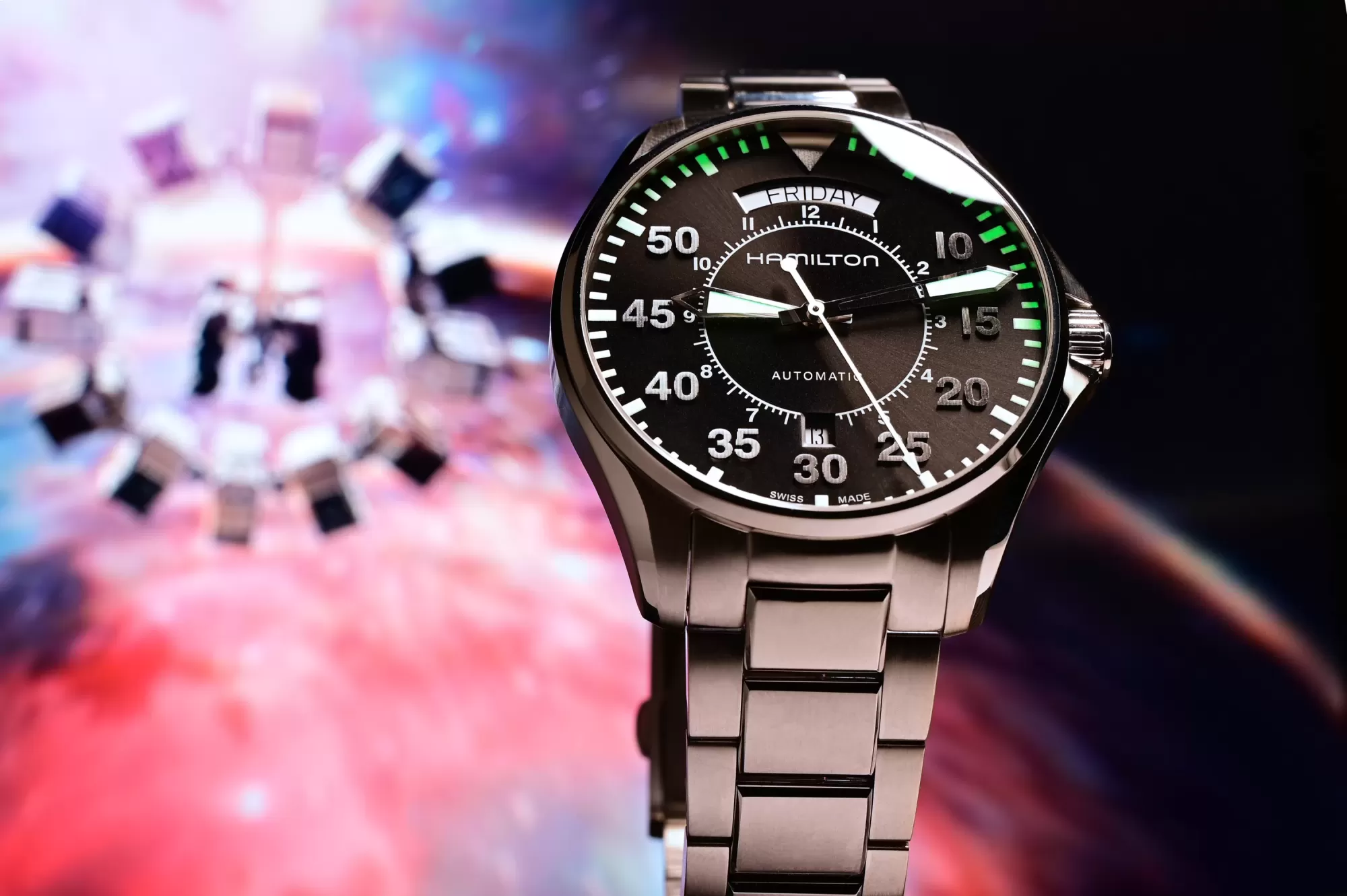

In 2026, twelve years after Interstellar hit cinemas in 2014, I still think it is a masterpiece and probably the greatest film about time travel ever made. The film’s protagonist, Cooper, wears a Hamilton Khaki Aviation Pilot Day Date Auto (H64615135), which I had to have as a huge Christopher Nolan fan. Inception had already led me to the TAG Heuer Carrera Calibre 5 I reviewed earlier. But why the Coop and not the Murph? The answer is simple: I had an offer I couldn’t refuse back in 2021. The Murph is still on my list and I’ll get one if a similar offer comes along.
The 42mm Case: Dimensions and Fit on My Wrist
My wrist measures 7.5 inches now, down from 8 inches before my recent weight loss. I had removed one link from the bracelet at 8 inches and have now removed a second. Even on my smaller wrist, the Cooper sits perfectly and looks right to me.
With a digital caliper I measured the case at 42 mm without the crown and 45.5 mm including it. The lug tips are 48.2 mm apart, while the span from one bracelet link to the other is 53.4 mm. That extra span across the bracelet is worth knowing when judging the fit from the 42 mm case diameter alone. I measured the watch’s height at 12.5 mm, slightly more than the official thickness of 11.85 mm listed by Hamilton.
On my wife’s 6.5 inch wrist, the Cooper still looks good to me. It does not wear as large as the numbers might suggest, so I would tell someone with a smaller wrist who loves the watch to try it. I also own a 48 mm watch that is fine for a day but is not my daily choice. The Coop is a different proposition, especially when I take it off the bracelet.
The Coop on Leather, Rubber and NATO
The 42 mm case does not tell the whole story of how this watch wears. On the bracelet I measure 53.4 mm from link to link, compared with 48.2 mm between the lug tips. Leather, rubber and NATO straps remove that extra rigid span and follow the shape of the wrist. The lugs themselves curve down towards the wrist. In watch terminology these are called downturned lugs and to my eye they make the Coop easier to wear than its diameter might suggest.
Below, I’ll show you a few pictures of how the Coop looks on leather, rubber and NATO. In my opinion, these options can make it a daily driver even for a smaller wrist, despite its 42 mm case.
The Original Bracelet: Comfort, Adjustment and Clasp
Let’s finish talking about fit by going back to the bracelet. It is pretty comfortable, with edges that feel good against my wrist. It tapers from 20 mm at the lugs to 18 mm at the clasp. Adjusting it is easy thanks to two shorter links, one on each side of the bracelet. They are not half links, just smaller ones. The clasp also has three micro-adjustment holes for a finer fit.
The clasp itself is beautifully machined and the Hamilton logo inside is a cool touch. My complaint is that you have to press it firmly to make sure it closes. It has fooled me several times: I thought it was shut, only for it to open by itself. This happens especially at the tightest micro-adjustment setting, with the bracelet tucked as far inside the clasp as it will go.
The Case Quality, Crystal and Caseback
The case is superbly finished, with brushing across most surfaces and polish on the small fixed bezel and the edges along the sides. The beautiful crown guards frame a crown marked with that cool Hamilton H.
Above the dial sits a slightly domed sapphire crystal with AR coating. When you look at the watch from an angle, the crystal distorts the dial in a way I find simply stunningly beautiful.
Turn the watch over and you find a crystal window in the caseback, which is held in place by four screws. It is unfortunate that this rear crystal is not sapphire, but seeing the movement and its beautifully crafted rotor is still a nice touch.
Neither the crown nor the caseback screws down, but the Coop is still rated for 100 metres of water resistance, which is enough for heavy rain and casual swimming when the seals are in good condition.
Dial Design, Legibility and Lume
The Coop has a proper pilot dial, with large hands and numerals that are easy to read at a glance. What I particularly like are the applied markers from 10 to 50 minutes and the triangle at 12. They rise above the dial and their finely ridged edges catch the light so well that the markers look as if someone has switched them on.
The day and date are pretty cool to have, especially with the day at 12 and the date at 6. This layout gives the whole dial a nice symmetry that looks very good to an OCD guy like me.
The lume is on the hands and around the edge of the dial at almost every minute mark, except 59, 00 and 01. When I go from sunlight into the dark, it glows pretty brightly, especially on the hands. It is not the brightest lume I have seen, but it lasts, with the hands remaining visible longer than the small markers.
The H-40 Movement: Accuracy and Power Reserve
Inside the Coop is Hamilton’s H-40, an automatic movement based on the ETA 2834-2. The original ETA movement offered a power reserve of about 38 hours, while the H-40 stretches that to 80. The trade-off is visible in the seconds hand: the H-40 runs at 21,600 beats per hour, or six beats per second as I like to call it, compared with the ETA’s 28,800 beats per hour and eight beats per second. The Coop’s seconds hand is simply not as smooth.
The day and date both jump into place around midnight rather than slowly creeping across their windows, which feels very premium to me. To set them, I pull the crown out one click and turn it clockwise for the date or counterclockwise for the day. For the day, it usually takes two spins of the crown to bring the name fully into the window, as one spin leaves it sitting between two days.
One reminder when setting the watch: Hamilton advises against correcting the day or date between 8 p.m. and 2 a.m. I find it easier to move the hands to about 6:30 before using the quickset, safely away from the midnight changeover.
Now to the nerdy part. Some of you emailed me asking for timegrapher photos of the Coop in different positions, so here are the readings from all six.
I wound the watch with 50 full rotations of the crown and waited at least 20 seconds in each position before recording the readings. I did not bother setting the lift angle because I was only interested in rate and beat error.
I do not wear the Coop two days in a row, so I can only speak to how it performs from morning until I take it off for bed. Over those hours, it usually loses no time at all, sometimes about one second and only rarely two. Considering this is not a COSC certified watch, I think Hamilton put a pretty good movement inside. I have not had mine serviced since I bought it, because it has never been an everyday watch for me.
Final Thoughts: Five Years With the Cooper
Five years later, it still blows my mind that I own such a cool watch, the same model Cooper wore in Interstellar. Almost every time I put it on, I feel special and get a flashback to 2021, when I bought it and watched the film again. For a moment, it feels like everyone around me has been getting older while I am still living in that year.
Would I buy it again? The better question is whether I would ever sell it. The answer is no, never. The fact that it appeared in a masterpiece is one thing, but the quality of the watch and the movement you get for the money are simply stunning.
How I photographed this watch
For the photos in this article, I used the Fujifilm X-M5 with the 15-45mm zoom lens for the lab shots. The last wrist shot is with the Samsung Galaxy S23 Ultra and the remaining with the Nikon ZF with 105mm Z Macro.
Be the first to comment