
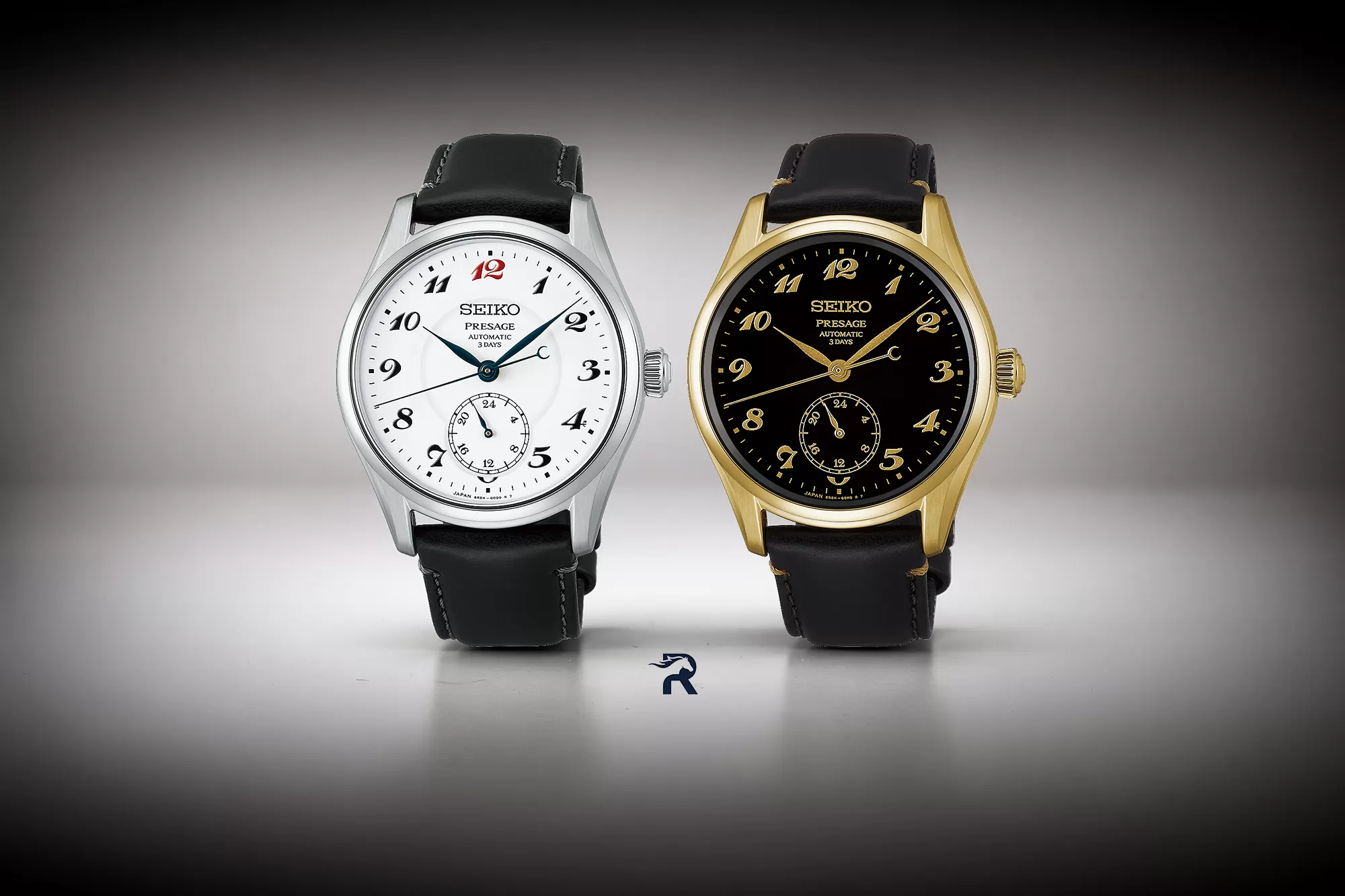

Seiko has introduced two new Presage Classic Series Craftsmanship watches that return to one of the most important designs in its history. The HCC005J1 uses a handmade white enamel dial while the HCC006J1 takes a darker route with black Urushi lacquer and a yellow-gold-coloured case. Both were announced on 13 August 2026 and are scheduled to reach Seiko boutiques and selected retailers in September 2026.
These are not simple colour changes. Each model uses a traditional Japanese dial technique and each has its own character. The white version is the clearer tribute to Seiko’s original Laurel wristwatch from 1913. The black model keeps the same basic layout but changes the mood completely through lacquer, gold details and a warm case finish.
A Return to the 1913 Laurel
The Laurel is important because it was Japan’s first wristwatch. Its white enamel dial, expressive Arabic numerals and red 12 became a clear visual signature. Seiko has used those details before, but the HCC005J1 brings them together in a convincing modern package. The red numeral at 12 immediately catches the eye while the curved black numerals and blue hands keep the design easy to recognise.
The new watches also add a 24-hour display at six o’clock. It gives the dial a little more depth without disturbing the balance of the numerals. This is not an independently adjustable second-time-zone function. It follows the main time and shows whether the watch is indicating the first or second half of the day.
HCC005J1: White Enamel and Blue Hands
The HCC005J1 has the brighter and more traditional appearance of the pair. Its dial is made under the direction of enamel craftsmen Mitsuru Yokosawa and Kazunori Uchiyama. Enamel requires careful preparation and repeated firing at high temperature. Small changes during this process can affect the final surface, which means the result depends on the skill and experience of the people making it.
A gently recessed centre adds shape to the white dial. Black Arabic numerals surround the blue hour and minute hands while the red 12 supplies the strongest colour accent. The blue hand on the 24-hour subdial keeps that display connected to the main handset. The polished stainless-steel case has Seiko’s super-hard coating for extra resistance against everyday marks. It is paired with a black leather strap and a three-fold clasp with push buttons.
HCC006J1: Black Urushi Lacquer and Gold Details
The HCC006J1 uses a handmade black Urushi lacquer dial produced by Toshikazu Tsuji, his daughter Mitsuki Tsuji and their team under the supervision of lacquer artist Isshu Tamura. Urushi is applied in layers and polished to create a deep surface that looks different as the light changes. The black background makes the gold-coloured numerals, markings and hands stand out clearly.
Its stainless-steel case receives a yellow-gold-coloured PVD coating. It is important to be clear that this is coated steel rather than solid gold. That choice gives the watch a much warmer and richer appearance without moving it into solid-gold pricing. A dark brown leather strap with matching warm stitching completes the design. The result is more dramatic than the enamel model while still using the same Laurel-inspired numerals and familiar Presage case.
Shared Case and Wrist Size
Both references measure 39.6mm across, 46.8mm from lug to lug and 12.4mm thick. The lug width is 20mm. Those proportions should make them easier to wear than the diameter alone suggests. On a 6.5-inch wrist, the 46.8mm length should remain manageable although the 12.4mm height means neither watch will feel extremely thin.
A dual-curved sapphire crystal protects each dial and has an anti-reflective coating on its inner surface. The back includes a clear window for viewing the movement. Magnetic resistance is rated at 4,800 A/m. Water resistance is only 3 bar, which is best treated as protection against splashes rather than an invitation to swim. That is the most obvious practical limit in the specification.
Calibre 6R5H and a Three-Day Power Reserve
Inside both watches is Seiko’s automatic calibre 6R5H. It can also be wound by hand and includes stop-seconds for setting the time more accurately. The movement has 24 jewels and offers approximately 72 hours of power reserve. That is enough for the watch to be left off the wrist for most of a weekend and still be running when it is picked up again.
Seiko states an accuracy range of plus 25 to minus 15 seconds per day under normal conditions. That is the official tolerance rather than a promise that every example will use the full range. The 24-hour indication is built into this calibre and gives these models a feature that is easy to understand at a glance. Buyers who prefer a completely simple dial may question the subdial, but it has been placed neatly and does not cover the large hour numerals.
Price and September 2026 Release
The HCC005J1 is priced at €1,400 and £1,250. That is approximately $1,690 based on current currency conversion, not a confirmed United States retail price. The HCC006J1 costs €1,600 and £1,400, equal to roughly $1,890 by the same method. Regional prices can differ once local taxes and distribution costs are included.
Both watches are due in September 2026 and neither is a limited edition. They will be part of the continuing Presage collection, so buyers should not have to race for a numbered piece. That is welcome because handmade enamel and Urushi dials deserve to be available for more than a short launch window.
Conclusion
The HCC005J1 and HCC006J1 show two very different ways to use the same historical design. The white enamel model is the closest link to the 1913 Laurel with its red 12, black numerals and blue hands. The black Urushi model is warmer and more striking, especially with its gold-coloured case and markings.
The strongest points are the handmade dials, sapphire crystals, wearable case dimensions and useful three-day movements. The limited 3-bar water resistance is less impressive, but these watches are clearly built around traditional dial craft rather than outdoor use. Neither model is a limited edition. Instead, Seiko is offering two permanent choices with real visual differences, which makes this pair more interesting than another routine colour update.
Be the first to comment