
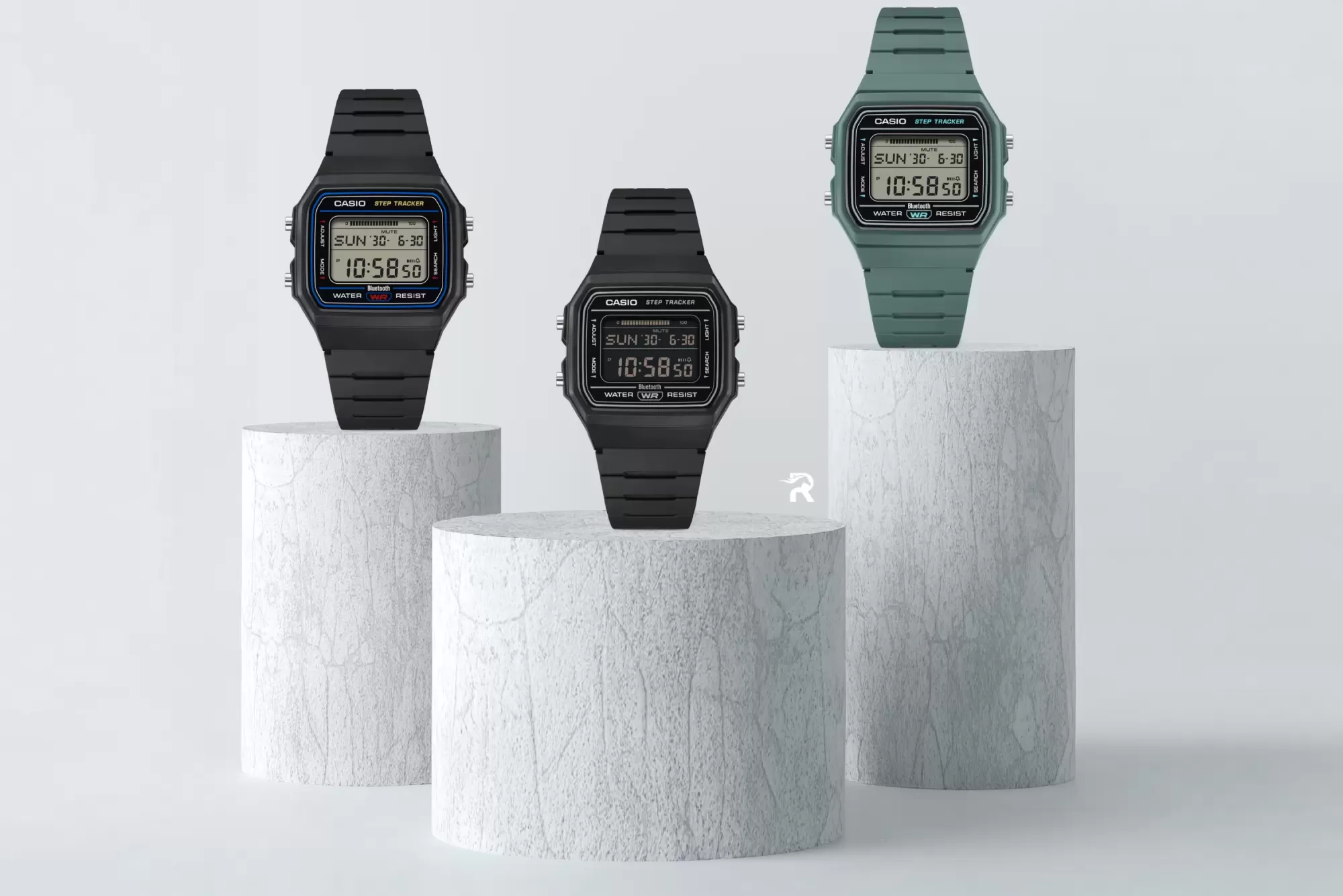

Casio has listed the F-B100W, a three-watch family that adds Bluetooth and step tracking to its uncomplicated digital formula. Japanese retailers opened preorders at ¥8,800 including tax, with release scheduled for August 2026. Prices for Europe, the UK and the US remain unannounced; the passport stamps are still pending.
That is the whole idea in one image: a familiar rectangular Casio that can correct its time through a phone and count your steps. The F-B100W-1AJF makes the clearest introduction, with a black resin case, positive LCD and blue, red and gold labels. The small step indicator above the time is the clue that this is not simply another colour of an old watch.
The F-91W connection is official
Casio says the front and strap design inherit the look of the F-91W, introduced in 1989. The new case measures 41.9 × 38.1 × 8.8mm and weighs 26g. An F-91W is 38.2 × 35.2 × 8.5mm and 21g, so the newcomer is larger, but only just.
On my 6.5-inch wrist, the dimensions suggest an easy, compact fit, although I have not handled one yet. The resin case, resin glass and 145–215mm strap range keep the specification familiar. The main resin parts of the band use biomass plastic, which is a quiet modern touch rather than a lecture printed on the dial.
Three colours, two screen personalities
The F-B100W-1BJF keeps the black case but adds grey markings and a negative display. It is not a more advanced model; it is simply the quieter sibling, for anyone who wants the LCD to whisper.
The F-B100W-3AJF moves in the opposite direction with muted sage-green resin, cool blue details and a positive display. The softer colour gives the square case a less technical look. The trio now covers weekday, midnight and houseplant without changing a single function.
Smarter, without becoming needy
An accelerometer counts up to 999,999 steps, while the daily target can be set from 1,000 to 50,000. The watch shows recent hourly progress and can remind you when you have been sitting still for too long. It does not measure heart rate, map runs with GPS or display phone notifications. Frankly, a watch that refuses to forward email may be the healthiest feature here.
Bluetooth connects it to the CASIO WATCHES app for automatic time correction, settings, life-log data, Time & Place records and phone finding. World time covers roughly 300 cities through the app. Away from the phone, the F-B100W is still a capable digital watch: dual time, five alarms, an hourly signal, a 60-minute timer, amber LED lighting and a stopwatch with storage for up to 200 lap or split records.
Casio estimates about two years from the battery, versus seven years for the simpler F-91W. That is the clearest trade-off for the extra sensors and radio. Without a smartphone connection, stated accuracy is ±15 seconds per month. Water resistance is described only as suitable for everyday use, with no metre or ATM rating, so this is a step counter, not a swimming coach.
The interface remains reassuringly old-fashioned: four physical pushers, a segmented LCD and no touchscreen gymnastics. A small upper graph shows step activity across the most recent seven hours, while the main display keeps the time easy to find. There is also a full automatic calendar, button-tone mute, low-battery warning and power-saving mode. These sound like minor comforts, but together they make the F-B100W feel more like a genuinely upgraded watch than a cheap activity band wearing retro clothes.
Price and availability
At ¥8,800, the F-B100W costs more than the bare-bones F-91W, as expected, but remains comfortably below most full smartwatches. All three references share the same price. The combination of a featherweight case, real buttons, useful fitness basics and no attention-hungry screen feels sensible. Casio has not reinvented its most recognisable digital shape; it has simply taught it to count steps and speak Bluetooth, then had the good manners to keep it quiet.
Be the first to comment