
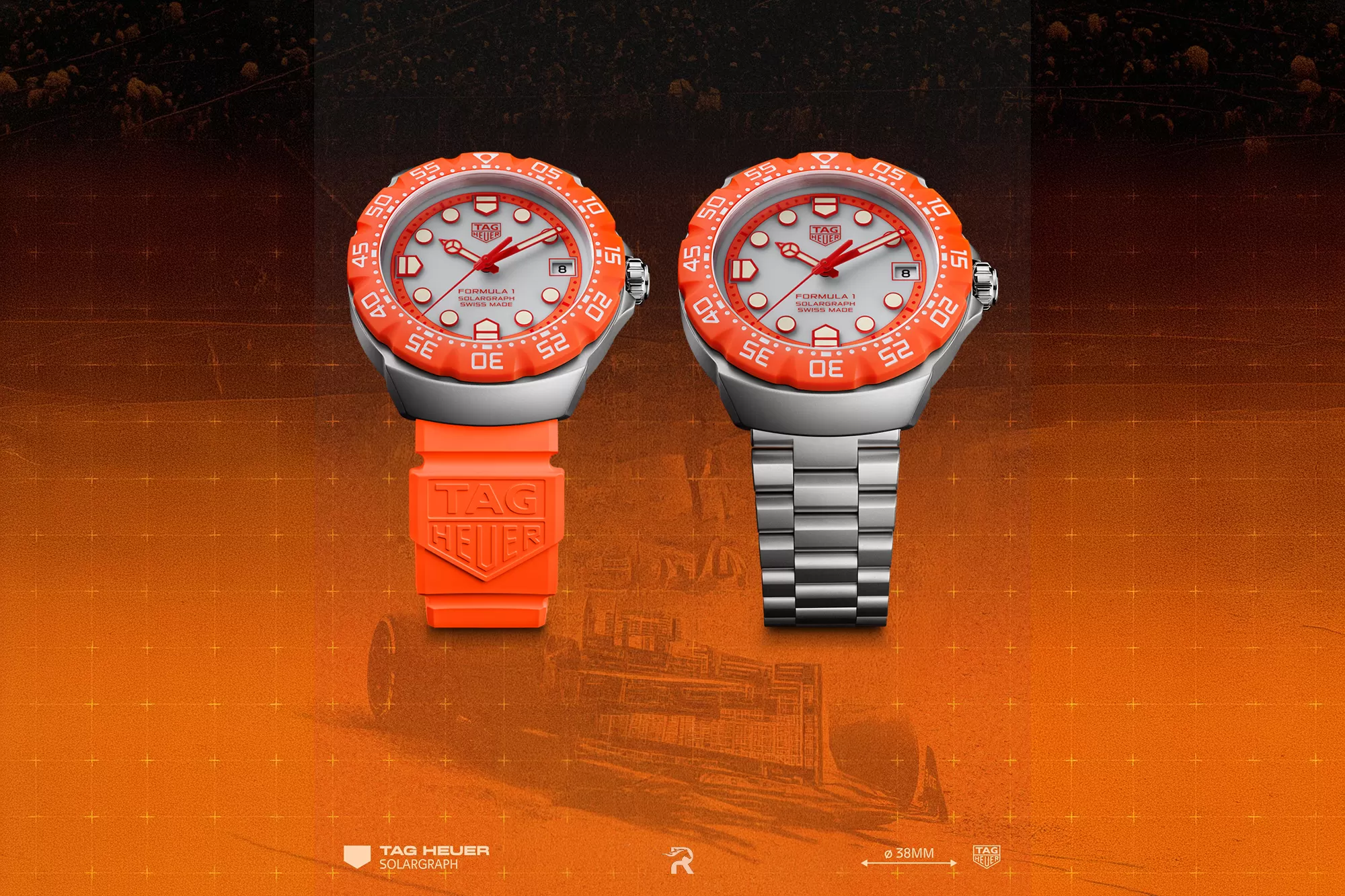
TAG Heuer is sending the Dutch Grand Prix off with a pair of bright orange Formula 1 Solargraph limited editions. The rubber-strap reference WBY111H.FT8128 and steel-bracelet reference WBY111L.BA0042 share the same compact case, solar movement and colour scheme, but they offer two very different ways to remember Zandvoort.
The timing is important. The 2026 Dutch Grand Prix will be the last Formula 1 race at Circuit Zandvoort under the current agreement. TAG Heuer has therefore created a farewell watch that looks straight into the orange grandstands rather than simply placing a race logo on an existing model.
The last Dutch Grand Prix at Zandvoort
The Dutch Grand Prix returned in 2021 after being absent from the calendar since 1985. The narrow circuit between the dunes quickly became one of the most recognisable weekends on the calendar, helped by steeply banked corners and grandstands filled with Dutch fans wearing orange.
The final race weekend runs from 21 to 23 August 2026. It will also include the first Formula 1 Sprint held at Zandvoort. Tickets for the weekend are already sold out, which says plenty about the event even as it prepares to leave the calendar.
TAG Heuer returned as Formula 1’s official timekeeper in 2025. A special watch for the last Zandvoort race therefore makes sense, especially when the Formula 1 collection already has a long history of bold colours and racing references.
Orange pulled from the Formula 1 archive
The original TAG Heuer Formula 1 arrived in 1986 with the bright colours and practical quartz movements that defined the collection. These Zandvoort editions use a similar idea in a more modern package. The orange is not a random national-colour shortcut. It also comes from TAG Heuer’s own Formula 1 archive.
A grey opalin dial provides a calm base for the orange-red flange, red-lacquered hands and applied indexes. The markers contain eggshell-coloured Super-LumiNova during the day and glow green in the dark. A framed date display sits at 3 o’clock while a red seconds hand keeps the dial from looking too quiet.
The bright bidirectional bezel is made from TH-Polylight, TAG Heuer’s lightweight bio-polyamide material. Its raised shape and large white scale bring back the playful look of the early Formula 1 watches without making the new model feel like a simple copy.
A 38mm steel case made for daily use
Both references use the same sandblasted stainless steel case. It measures 38mm across, 45.2mm from lug to lug and only 9.9mm thick. The compact dimensions should make it comfortable on many wrist sizes while the short, rounded case keeps the unmistakable Formula 1 shape.
The watch has an 18.5mm lug width, a steel crown and a screw-in steel caseback. A sapphire crystal with an antireflective coating protects the dial. Water resistance is 100 metres, so this is not a delicate race-weekend souvenir that needs to stay away from water.
The caseback has a chequered pattern around the TAG Heuer shield plus the water-resistance marking and limited-edition text. The rubber version is engraved “One of 1500” rather than receiving an individual number.
The TH50-00 Solargraph movement
Inside both watches is the TH50-00 solar quartz calibre produced with La Joux-Perret. It converts natural or artificial light into electrical energy through the dial. One minute of light can provide enough power for a full day while a complete charge gives the watch up to ten months of autonomy.
A full charge takes about 40 hours in sunlight. In normal use the watch keeps topping itself up, so the owner should not need to think about charging it. The rechargeable battery has an expected lifespan of up to 15 years. Functions remain simple and useful: hours, minutes, seconds and date.
The metal version: WBY111L.BA0042
Reference WBY111L.BA0042 is the metal-bracelet choice. The watch head is otherwise the same, but the perforated orange rubber strap is replaced by a three-row stainless steel bracelet. Its sandblasted finish matches the case and reduces the amount of orange visible on the wrist.
The bracelet closes with a double-security folding clasp. This version is limited to 1,000 pieces and is sold as an online exclusive, making it scarcer than the rubber model. It is also the easier choice for somebody who likes the orange dial and bezel but does not want a completely orange strap.
Prices and availability
The WBY111H.FT8128 on rubber is priced at $2,150, €2,100 or £1,800. The WBY111L.BA0042 on steel costs $2,250, €2,200 or £1,900. In every region the bracelet adds only 100 units of the local currency, which makes it an unusually easy upgrade to consider.
Both references are listed as coming soon, with an online presale scheduled before the race weekend. A small allocation is also expected to be available at Zandvoort. The orange rubber version has the larger run of 1,500 pieces while the online-only steel version stops at 1,000.
Conclusion
The steel model is more versatile and costs very little extra, but the rubber version tells the Zandvoort story more clearly. If I were buying one specifically to remember the final Dutch Grand Prix, I would choose WBY111H.FT8128 and accept the full orange treatment.
Both watches get the important parts right: a compact steel case, sapphire crystal, useful water resistance and a solar movement that can run for months without attention. The result is a proper watch with a strong event connection, not simply a standard model with a commemorative logo added at the last minute.
Be the first to comment