
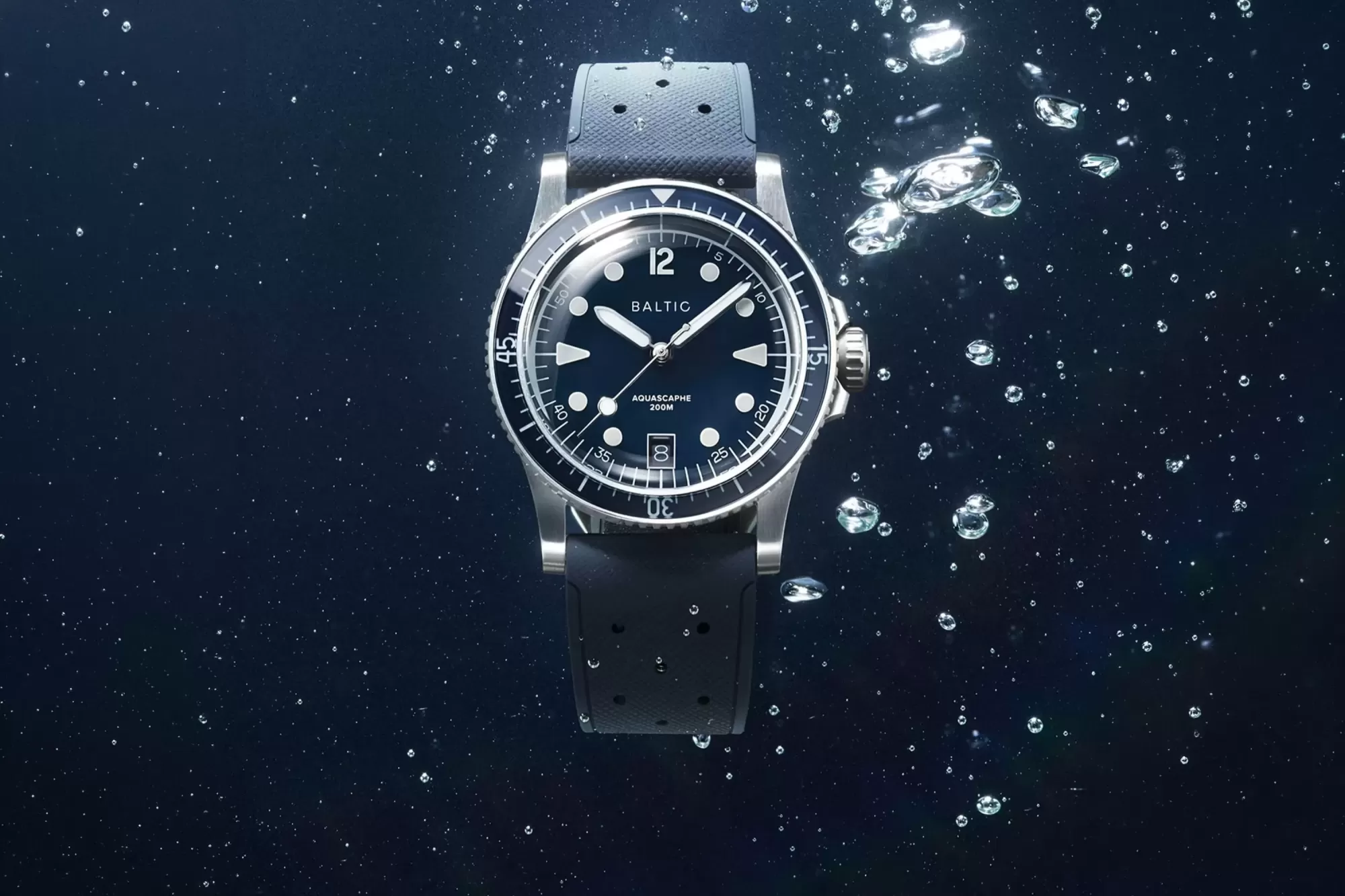

The Baltic Aquascaphe MK2 is getting its first date display. This is not a replacement for the clean no-date model and it is not a limited edition. Instead, Baltic has added “Date” as a new choice across the existing MK2 range, giving buyers a useful complication without changing the case size or thickness.
That distinction matters because the Aquascaphe MK2 itself is not new. Baltic introduced the second-generation model in September 2025. The news at the end of July 2026 is that customers can now order it with a date window, with deliveries scheduled for the end of August.
The date is available with all four current dial colours and both case sizes. The blue and green versions have glossy dials, while the grey and warm silver models use a more textured, grained finish. Baltic does not list separate traditional reference numbers for every combination; diameter, date and strap are selected when configuring the watch.
A date window that respects the dial
Adding a date to a carefully balanced dive-watch dial can easily create a mess. Baltic has taken the safer route by placing the window at six o’clock, directly above the 30-minute bezel marker. The frame is finely bevelled and the date disc is matched to the dial colour, so the display looks like part of the design rather than a white rectangle added at the last moment.
The placement also preserves the vertical balance created by the applied Arabic 12. It replaces the round six o’clock marker, but it does not push the logo or the Aquascaphe text into awkward positions. Buyers who still prefer perfect marker symmetry can simply choose the no-date version.
Four dials and two genuinely useful sizes
The date option can be combined with either a 37mm or 39.5mm case. The smaller watch measures 45mm from lug to lug, while the larger one measures 47mm. Both are 12.9mm thick including the double-domed crystal, or 10.7mm if the crystal is excluded, and both use a standard 20mm lug width.
Those measurements give buyers a real choice rather than a token difference. The 37mm version should suit smaller wrists and people who like the compact proportions of vintage dive watches. The 39.5mm version has more presence without becoming oversized.
The blue and green dials offer the strongest colour, helped by matching sapphire bezel inserts. Grey is the most restrained choice, while warm silver creates the clearest vintage look and pairs its pale dial with a black bezel. All four use Baltic’s “Maxi Dial” layout, with large applied Lumicast hour markers. These 0.4mm-thick blocks contain BGW9 Super-LumiNova and are matched by broad, faceted luminous hands.
The case remains a proper dive-watch case
The Aquascaphe MK2 uses 316L stainless steel, a screw-down crown and a solid caseback engraved with geometric waves. Water resistance is 200 metres, so the date model keeps the same practical dive-watch specification as the no-date version.
The unidirectional bezel has 120 clicks and a fully graduated minute scale. Its insert is sapphire, while the double-domed sapphire crystal over the dial has an anti-reflective coating on the inside. Sapphire on both surfaces is a strong feature at this price because it offers much better scratch resistance than acrylic or mineral glass.
Baltic also gives the case more detail than the basic measurements suggest. The tops of the lugs are vertically brushed, the sides use horizontal brushing, and the flat upper surface of the crown guard is polished. Drilled lugs make strap changes easier and fit the watch’s tool-watch character.
The Miyota 9015 is the important mechanical change
The no-date Aquascaphe MK2 continues to use the Miyota 9039. Selecting the date changes the movement to the Miyota 9015, the date-equipped member of the same slim movement family. This is why Baltic can add the complication while keeping the watch exactly 12.9mm thick.
The 9015 is only 3.90mm high and 26mm in diameter. It has 24 jewels, runs at 28,800 vibrations per hour, or 4Hz, and offers more than 42 hours of running time. It supports automatic winding, hand winding, hacking seconds and a quick-set date.
Miyota gives the movement an official accuracy range of −10 to +30 seconds per day. That is a factory tolerance rather than a chronometer promise, but it is tighter than the ranges quoted for many basic automatic movements. It is also a widely used calibre that should be straightforward for an independent watchmaker to service.
Rubber, two steel bracelets and clear pricing
The base option is Baltic’s FKM Rubber Classic strap, which has a fine saffiano-style texture. Buyers can also choose a beads-of-rice bracelet for a softer vintage look or a flat-link bracelet for a cleaner, more modern appearance. All of Baltic’s 20mm straps are compatible, and the medium Rubber Classic is listed for wrists up to 20.5cm.
The date model costs €655 on rubber or €720 on either steel bracelet before destination taxes. That is only €25 more than the equivalent no-date watch, making the complication a modestly priced upgrade.
Baltic takes payment in euros and shows estimated local-currency figures according to the delivery country. At the time of writing, the rubber model is estimated at approximately $746.70 in the United States and £558.72 in the United Kingdom, with local taxes and import charges excluded. In Spain, the same configuration is €792.55 including 21% VAT. Regional totals will therefore vary even though the underlying Baltic price is the same.
Every version comes with a 24-month warranty, and the first date-equipped orders are scheduled for delivery at the end of August 2026.
Conclusion
The Aquascaphe MK2 Date is a small update done properly. Baltic did not enlarge the case, increase the thickness or remove the no-date choice. It added a useful display at the most balanced position on the dial and moved to a slim, proven movement with a 4Hz beat rate, hacking, hand winding and a quick-set date.
The €25 price difference also feels fair. Some buyers will always prefer the cleaner no-date dial, but anyone who wears one watch through the working week may find the new display more useful. I would choose the 39.5mm case for my 6.5 inch wrist, then decide between the glossy blue on rubber and the green on beads of rice. Either way, this is a practical addition to the range rather than change for the sake of change.
Be the first to comment