
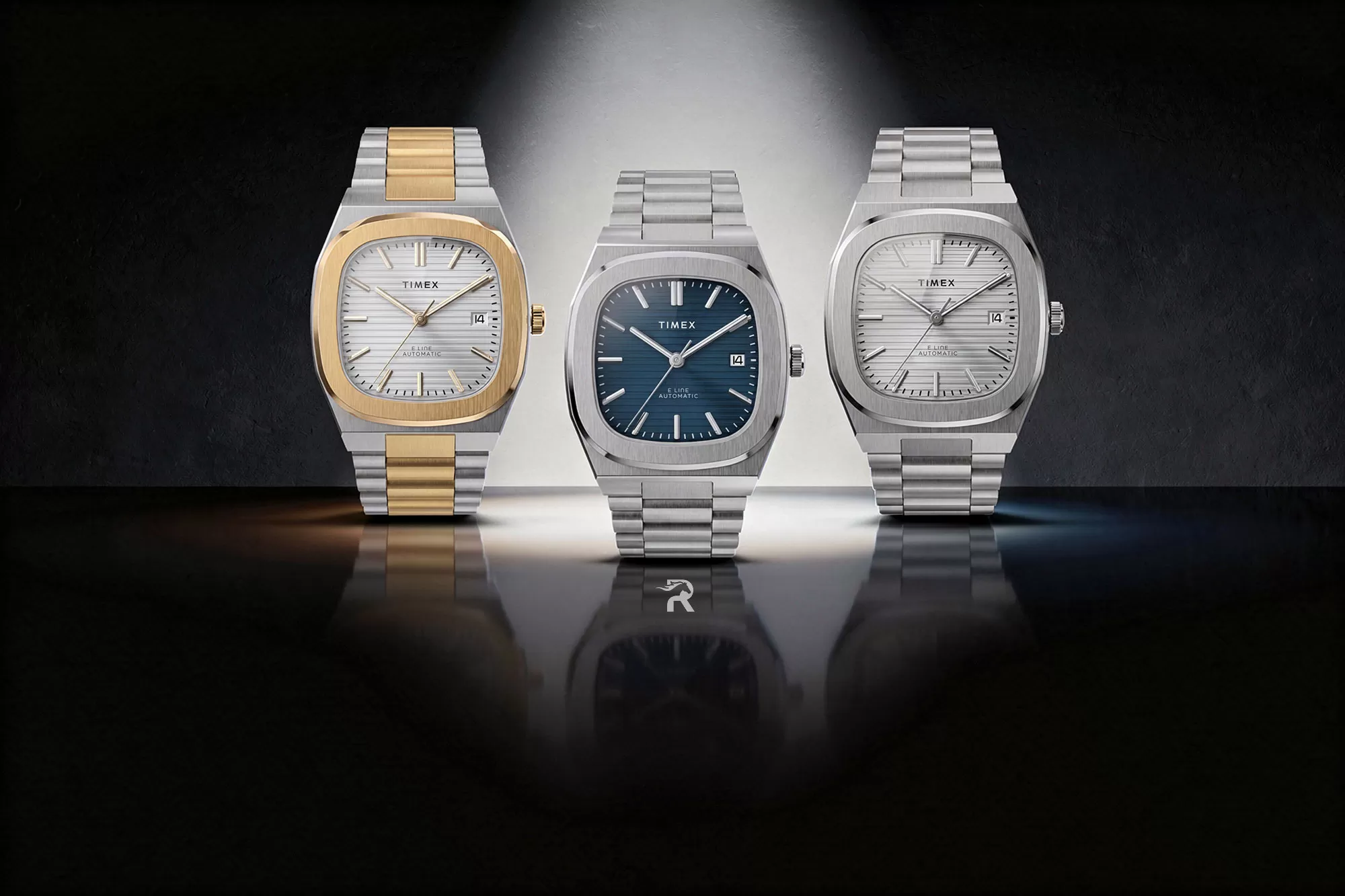

Timex has introduced a larger 38mm version of the Automatic E Line, turning the compact design that returned in 2024 into a more substantial watch with an integrated-bracelet appearance. The new range includes the silver TW6A00500, the two-tone TW6A00600 and the teal TW6A00700. All three share the same case dimensions, Japanese automatic movement, horizontally textured dial and date display.
This is not the first modern E Line. Timex revived the design as the Automatic 1983 E Line Reissue with a 34mm rounded-square case. That watch followed the size and simple character of the original more closely. The 38mm models keep the familiar TV-shaped outline but move the collection in a more modern direction. They are larger, thicker and fitted with a conventional butterfly clasp instead of the tool-free expansion band used by the smaller version.
A 1983 Timex design in a much larger case
The E Line name reaches back to a Timex watch from 1983. Its rounded-square case became known as a TV dial shape. The E Line name was connected to New York’s E subway line, which carried commuters toward Manhattan’s business district. The modern 34mm reissue brought that idea back in November 2024 with a stainless-steel case, an acrylic crystal and a Japanese automatic movement.
The new watch is better described as a larger update inspired by that reissue rather than a strict recreation. Its 38mm stainless-steel case measures 45.5mm from end to end and 12.5mm thick. Those figures should give it noticeably more presence than the 34mm model. The short overall length should stop it from becoming excessive, although the wide square shape will probably look larger than a round 38mm watch.
With my approximately 8-inch wrist, this is the E Line size I would choose. The bracelet is stated to fit wrists from 150mm to 205mm, or about 5.9 to 8.1 inches, so I would be very close to its upper limit. Anyone with a similarly large wrist should check the fit before ordering or confirm whether extra links are available.
Brushed steel, polished edges and a 12.5mm profile
The case and bracelet combine brushed and polished surfaces. Vertical brushing across the broad upper case makes the shape easy to see, while polished borders add contrast around the dial opening. The bracelet flows directly into the case and closes with a butterfly deployant clasp. Timex lists the attachment width as 12mm, but this is not a watch designed for easy experiments with ordinary leather or fabric straps.
At 12.5mm thick, the Automatic E Line is not especially slim. Part of that height comes from the Miyota movement and the exhibition back. The side view also shows that the case body, bezel and flat crystal form several clear layers. The result should feel more substantial than the original 34mm E Line, even before the four-millimetre increase in width is considered.
Three versions with the same striped dial pattern
The TW6A00500 is the simplest version. Its silver-tone dial, case, hands, markers and bracelet create a clean monochrome appearance. Horizontal lines run across the dial, while applied baton markers and a printed minute track keep the display easy to read. A framed date window sits at 3 o’clock, with the Timex name above the hands and E Line Automatic printed near 6 o’clock.
The TW6A00600 keeps the silver dial but introduces gold-tone details. The bezel, crown, hands, markers and centre section of the bracelet receive the warmer colour, while the main case and outer bracelet links remain silver-tone. It is the most noticeable model and also the most expensive of the three.
The TW6A00700 uses a teal dial with the same horizontal pattern, paired with an entirely silver-tone case and bracelet. This is my preferred version. The colour makes the dial texture more obvious without turning the watch into something difficult to wear. It also gives the design more personality than the silver model while avoiding the stronger look of the two-tone option.
Mineral glass is the obvious compromise
All three watches use a flat mineral crystal. Mineral glass is tougher than ordinary acrylic and can handle everyday use, but it is more vulnerable to scratches than sapphire. At this price, sapphire would have made the specification much stronger, especially because the broad crystal is such a visible part of the design.
Water resistance is 50 metres. That is enough for rain, hand washing and light swimming, but this is not intended for diving or snorkelling.
The familiar Miyota 8215 remains inside
The movement is the Japanese Miyota calibre 8215, visible through the exhibition caseback. Timex states a power reserve of up to 40 hours, while Miyota’s current technical information gives an approximate running time of 42 hours. It has 21 jewels, runs at 21,600 vibrations per hour and supports both automatic and hand winding.
The movement also provides stop seconds and quick date correction. Its official accuracy range is -20 to +40 seconds per day. This is a long-established, practical automatic calibre rather than a highly decorated movement, although the signed Timex rotor makes the view through the back more specific to the watch.
Prices and availability
The silver TW6A00500 costs $379 in the United States, €369 in Europe and £325 in the United Kingdom. The two-tone TW6A00600 is priced at $399, €389 and £335. The teal TW6A00700 costs €369 or £325. At the time of writing, that teal reference is not listed on the official United States store.
The European and British stores show the watches available to add to the basket. The United States listings for the silver and two-tone versions are marked as pre-orders. These are regular-production models, with no announced numerical limit.
Conclusion
The 38mm Automatic E Line gives people who liked the 1983-inspired shape but found the 34mm reissue too small a much easier option. Its 45.5mm length remains controlled, the textured dials are more detailed and the integrated steel bracelet suits the broader case. The Miyota 8215 is simple, widely used and easy to understand.
My main reservation is the mineral crystal. A sapphire crystal would have been appropriate when the steel models are close to $400. Even so, I prefer this 38mm format for my 8-inch wrist. The teal TW6A00700 would be my choice. It has the strongest dial colour, keeps the case entirely in silver-tone steel and makes the horizontal texture the main attraction.
Be the first to comment